The Curve That Changed Everything: How a Forgotten 1925 German Patent Became the Foundation of Modern High-Speed Machining
He did not come to lecture.
Mickey Berman — Inventor and Chief Scientist of iMachining, with multiple patents spanning machining and rapid prototyping — arrived at my home in Pune and walked straight into my kitchen.
iMachining was not a solo endeavour. Mickey was the chief inventor and driving force behind the technology, working alongside co-inventors whose brilliance was as indispensable to what iMachining became as the foundational idea itself.
Mickey came to India in 2016 for research that we were conducting together. And his love for Indian food was evident the moment he stepped out of Mumbai Airport. “Where are you taking me for Dinner?”. We fixed the place after some research and headed there. He just doesn’t love eating it. He loves cooking it more. His knowledge of Indian pickles and chutneys is in a league of its own. The man does not do anything halfway.
We are strict vegetarians at home. Mickey knew. He came prepared. That evening he cooked Aloo Matar curry (A spicy Potato Peas Curry) from scratch, working the spices with the same quiet confidence he brings to machining physics.
Somewhere between the tempering and the first taste, he explained something I had been trying to explain to others for years.
I am not a cutting tool scientist. I am a CAM Professional who used iMachining from 2011 through 2024, across hundreds of real parts and a material range that runs from aluminium to Inconel to Duplex stainless. Thirteen years of watching this theory play out on real machines under real production conditions. That is the lens this article is written through.
First, a correction the industry keeps getting wrong
Most people call this Solomon's Theory. The man's name was Carl Salomon. Dr.-Ing. Carl Salomon. A German engineering doctorate. One patent. Filed 27 November 1925. Granted 27 April 1931. Patent number DE 523 594.
No papers. No laboratory. No biography on record. No Wikipedia page in any language.
The correct spelling, for the record, is Salomon. Not Solomon.
He left one curve. That curve has quietly organised how the world thinks about cutting speed for nearly a century.
The Man Who Challenged Taylor
Frederick Winslow Taylor established the doctrine in 1907. Higher cutting speed means higher temperature. Higher temperature means faster tool wear. Manage the speed. Manage the temperature. Taylor's Tool Life Equation became the bible of metal cutting for generations of engineers. It was empirical, practical, and widely accepted.
Salomon challenged it.
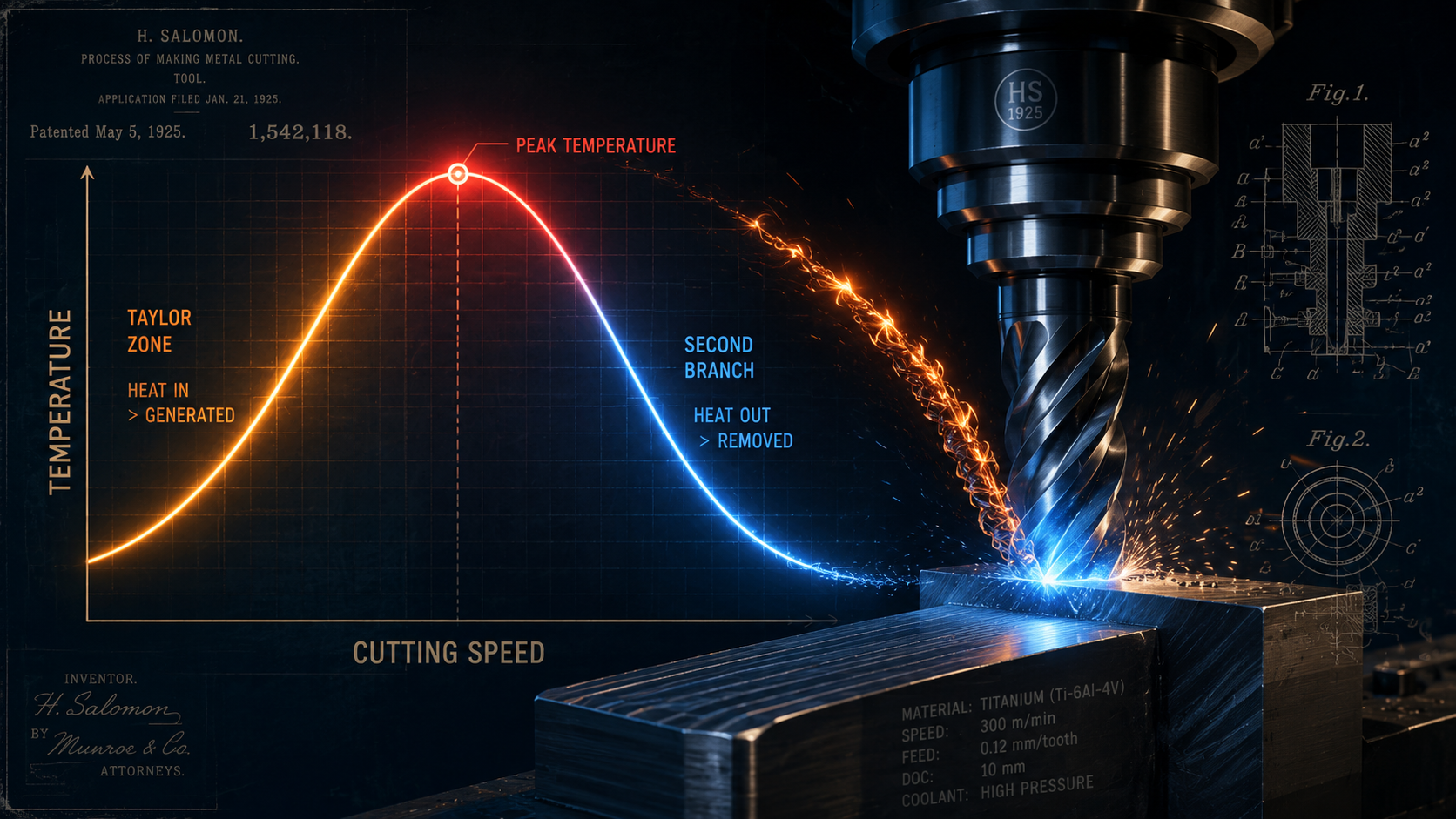
His experiments on aluminium, copper, and bronze produced a curve that rose with increasing cutting speed exactly as Taylor predicted. Then, past a critical threshold specific to each material, it turned back down.
Temperature drops. Force drops. Machining gets easier.
Push past that critical cutting speed and the material begins working with the cutter rather than against it. The chip carries the heat away. Contact time collapses. The tool survives longer precisely because it is running faster.
This was not a minor adjustment to Taylor's doctrine. It was a direct challenge to the foundational assumption that had governed metal cutting for nearly three decades. Salomon was saying that Taylor's curve was incomplete. That there was a second branch nobody had seen because nobody had looked far enough to the right.
For decades, serious researchers questioned whether the curve was real. Salomon's original explanation was challenged and eventually replaced by adiabatic shear theory, established by Recht in 1964 and confirmed by Komanduri and colleagues in a DARPA-funded program in 1982. The observation survived. The explanation was replaced. And the man himself disappeared from the technical literature entirely after 1931, leaving behind nothing but one patent and one curve.
The Man Behind the Curve
Before we go further, consider what we actually know about Carl Salomon.
He held a German engineering doctorate. He filed one patent. He conducted experiments on nonferrous metals at speeds that the spindle technology of his era could barely achieve. And then he vanished. No follow-up papers. No laboratory record. No professional biography. No Wikipedia page in any language.
Whether he emigrated, whether his career was interrupted by the upheavals of 1930s Germany, whether he simply chose silence — nobody knows. The most serious modern review of his work, published by Longbottom and Lanham in the International Journal of Machine Tools and Manufacture in 2006, refers to him simply as a German engineer. That is approximately everything the academic record can confirm.
A man with one idea, one patent, and no biography gave the machining world a concept that researchers are still testing nearly a century later.
That is not obscurity. That is legacy.
Then in 2023, Something Remarkable Happened
A research team at the Institute of Mechanics, Chinese Academy of Sciences, built a light gas gun cutting rig and cut titanium alloy Ti-6Al-4V at speeds up to 212.6 metres per second.
They were not testing a hypothesis casually. This was the most direct experimental test of Salomon's curve ever attempted.
What they measured was significant.
A clear tool tip temperature peak. Then beyond that peak, an unambiguous decline. Exactly the shape of Salomon's curve. Exactly where his theory said it would be.
They called their findings solid evidence. And they titled their paper with the intellectual honesty it deserved.
"Towards Salomon's Hypothesis."
Not proof. Not confirmation. Towards. Because real scientists do not overclaim.
But after decades of rigorous testing and debate, the most direct experimental test ever conducted pointed firmly in one direction.
The evidence was pointing firmly toward Salomon being right. Ninety-two years after he filed that patent.
What the Industry Does Not Know
Before I tell you what Mickey explained over that curry, I want to share something that stopped me when I saw it.
I ran a LinkedIn poll asking my connections who are predominantly CNC programmers and machine shop operators, a simple question. Do you know Salomon's Theory of High Speed Machining?
Thirty-six professionals voted in total. A small sample. I will not pretend otherwise. But the direction of the result is what matters.
41% had never heard of it. 22% had heard the name but could not explain it. 19% went and Googled it during the poll. Only 16% said they could explain it.
Small sample or not, consider what that direction is telling us. Salomon's Theory has been commercially implemented by exactly one CAM system in the world. Only one product has ever taken that 1925 curve and built an automatic cutting parameter calculator around it. And 84% of the professionals most likely to benefit from understanding it have never encountered it.
That is not a gap in education. That is a measure of how far ahead of its time one idea — and one product — has been operating.
Salomon's curve lives inside the Technology Wizard of iMachining. The software works. The theory stays invisible. And a generation of skilled professionals runs on a foundation they were never shown.
That is precisely why this article exists.
The Question Every Tooling Professional Asked Me
In my early days demonstrating iMachining, nearly every tooling professional I demonstrated it to asked some version of the same question.
"Why does iMachining recommend a cutting speed that feels too aggressive? Our tools are not meant for this."
Then we would cut a part. Same tool. Same high cutting speed that made them uncomfortable. And something would happen that their experience told them should not be possible.
The tool ran cool. The part came out right. Tool life actually improved.
Consistently, without a single exception I can recall, they would reluctantly agree. Something was happening that their experience said should not be possible. They called it magic because they had no better word for it.
The word they were looking for was Salomon.
What Mickey Explained Over That Aloo Matar
Mickey explained to me that when he & his team designed iMachining, Salomon's second branch was the target. The speed at which the physics shifts in your favour. That is what the Technology Wizard calculates toward. Not approximately. Not directionally. Precisely. For every material, every tool, every machine and every cut.
Thirteen years of shop floor experience across a material range that runs from aluminium to Inconel to Duplex stainless confirmed every word of it.
But targeting the second branch is not enough on its own.
Four things must be exactly right. Not approximately right. Exactly right.
The feed rate must match the RPM precisely. Radial engagement must be controlled at every single point of the toolpath. Feed rate must be recalculated at each radial engagement value. And axial depth of cut must be absolutely correct.
Miss any one of these four and the tool will overheat, wear prematurely, or fail. The margins are way tighter than conventional machining. The cutting physics does not negotiate.
This is precisely what iMachining handles automatically. So the programmer does not have to.
Mickey built iMachining around a curve that a German engineering doctor drew in 1925 and that the world spent ninety years trying to fully understand. When iMachining debuted in 2009, that curve was its foundation.
One more thing worth understanding. Reaching the second branch requires a machine capable of the spindle speeds that Salomon's curve demands for a given material. Not every machine can get there. iMachining knows this. When the machine's spindle capability falls short of the theoretical second branch, the Technology Wizard does not fail. It recalculates. It finds the best possible operating point within what that specific machine can actually deliver. Most modern machining centres have the spindle capability to reach the second branch. Not all. iMachining works intelligently with both.
Thirteen Years. Hundreds of Parts. Aluminium to Inconel to Duplex.
In the HSM regime, iMachining's recommended speed often placed the cut on the cooler, descending side of the temperature peak. When programmers overrode downward — playing it safe — they moved the cut back toward the hotter, less stable zone. More built-up edge. Shorter tool life.
Consistently, the tool ran cool when the programmer trusted iMachining's recommendation. Chip colour confirmed it. Tool life was predictable.
Salomon's curve was not academic on those machines. It was present in every cut.
What This Means for Every Programmer Reading This
Salomon's curve is not history. It is a living operating principle. And now you know it exists.
The next time iMachining gives you a cutting speed that feels aggressive, pause before you override it. It is not guessing. It is calculating the precise speed at which the physics shifts in your favour. Pulling that number back does not make the cut safer. It makes it less efficient and potentially less stable.
Trust the curve. Not because a 1925 German patent told you to. Because ninety-two years of serious research and thirteen years of personal shop floor experience across materials that would test any cutting system, all point in the same direction.
The second branch is real. And iMachining has been finding it for you all along.
The Inventor and Chief Scientist of iMachining cooked me a vegetarian curry in Pune and explained all of this in a single evening.
The research community did what science demands. They questioned, tested, and insisted on evidence before accepting a claim that could not yet be fully proven. Ninety-two years of that rigour is precisely what makes the 2023 result significant.
Some ideas are simply ahead of their time.